11 min readOh Natta ·
Do short bursts of everyday movement count?
In this article 7 sections
"I don't have time to exercise."
I've heard that line more than any other in my years as a trainer, and honestly, I don't argue. Work, commuting, the house, the kids, ageing parents. We all get the same 24 hours. Nobody gets a bonus round.
But over the last few years, a group of researchers has been asking the question the other way round.
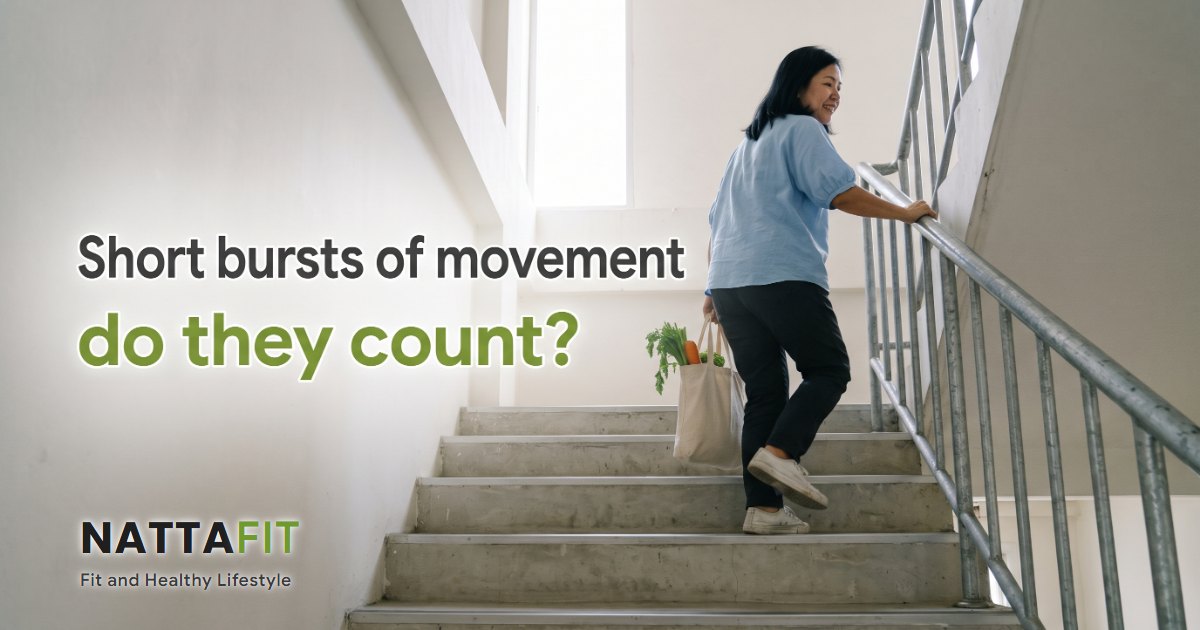
What if you don't exercise at all, but your day has a few moments where you move hard? Taking the stairs at a run. Power-walking for the bus. Hauling the shopping up to the third floor. A minute here, a minute there.
Does that count? 🤔
They gave it a grand name: VILPA, short for vigorous intermittent lifestyle physical activity. It sounds like a prescription drug. In plain words, it means short bursts of hard effort in ordinary life. When you do it on purpose, like three quick runs up the stairs a day, it's called exercise snacks.
If a proper workout is a full meal, these are the snacks you nibble between meals. The question is whether snacks alone can keep you fed.
The headlines were exciting. A few minutes a day, and the risk of dying from heart disease almost halves. As a trainer, I read that and thought, well, there goes my job. 🤣
But when I read the full papers one by one, I found there are two sides to this, and they need to be told together.
⌚ The first study: wrist trackers on 25,000 people
UK Biobank follows the health of about half a million people in Britain. Between 2013 and 2015, around 100,000 of them agreed to wear a movement tracker on their wrist, 24 hours a day, for a week. A personal CCTV camera that logs every move. Sneak an afternoon nap and it knows.
In 2022, Professor Emmanuel Stamatakis's team at the University of Sydney took only the people who said they did no exercise in their leisure time: 25,241 of them, average age about 62. A computer program then picked out every short burst of hard movement in their day. Not workouts. Just life.
Almost all of those bursts (92%) lasted less than a minute. Shorter than some of the ads you sit through before a video.
Over nearly seven years, 852 people died. Compared with people who had no bursts at all:
- Those with 3 bursts a day (the middle of the group, one to two minutes each) had a 38–40% lower risk of dying from any cause or from cancer, and a 48–49% lower risk of dying from cardiovascular disease.
- Even fewer than two bursts a day went with roughly a quarter lower risk.
- The curve kept going down in an almost straight line. More was better. It didn't stop at three.
The team also looked at 62,344 people who did exercise. Short bursts in non-exercisers produced almost the same curve as vigorous activity in exercisers.
Why might one minute matter? The researchers think it's about intensity.
Your heart and lungs are like a car. If it only ever crawls around the neighbourhood at 20 km/h, the engine never really works, and the first time you take it on the motorway, it splutters. A hard burst is a short trip on the motorway. The heart has to pump harder, the lungs have to move air faster, and if you do it often, the body upgrades the engine. Trials have confirmed that a few short hard bursts a day can improve heart and lung fitness within weeks.
🔬 What came next: cancer, diabetes, and women
The same team went back to the same data for other diseases, squeezing every last drop out of one lemon.
- Cancer (2023): in 22,398 people, 4.5 minutes a day went with 31–32% fewer of the 13 cancers linked to low physical activity (such as breast and bowel cancer).
- Type 2 diabetes (2026): in 22,706 people followed for almost eight years, 3.9 minutes a day went with 36% less diabetes.
- Major heart events, women vs men (2025): this is the one I find most interesting.
In 13,018 women, just 3.4 minutes a day went with 45% fewer major cardiovascular events (heart attack, heart failure, stroke and cardiovascular death), and 67% less heart failure. The link was already showing at 1.2–1.6 minutes a day.
In 9,350 men, 5.6 minutes a day went with only 16% lower risk, and that didn't reach statistical significance.
Why such a gap? The team measured it. Doing the same brisk walk or the same stairs, women were working at about 83% of their own maximum fitness, men at about 70%.
Same staircase, different heights. For many women, three flights is a proper workout. For many men, it's a stroll with steps. 😂
The researchers suggest men may need some deliberate vigorous exercise on top to get the full benefit.
✋ Hold on. These are observational studies
By now some of you want to sprint up the nearest staircase. Go ahead, it won't hurt. But let me tell you the other side first.
Every study above is observational. It looks at whether people who already move hard get sick less. Nobody was randomly assigned to move more and then followed to see if they got sick less.
Why does that matter? Picture this. On days when lots of people carry umbrellas, it usually rains. But umbrellas don't summon rain. People just read the sky. ☔
Stairs work the same way. People who can still run up the stairs may simply have been healthier to begin with. People whose hearts are starting to struggle quietly avoid the stairs, and the lift is always there, doors open, waiting with a warm welcome. Follow them for a few years and "people who don't take the stairs" get sick more. But the illness came first, and the stair-avoiding came after.
Stairs don't always make people strong. Sometimes strong people just aren't scared of stairs. Researchers call this reverse causation.
The team knew this and tried to guard against it. They dropped anyone who got sick or died in the first two years, and anyone who rated their own health as poor. The results held up. But none of that can replace an actual trial.
And the newest study drives the point home.
In 2026, the same team repeated the analysis in 3,293 American non-exercisers from a national health survey, a far more varied group than UK Biobank in ethnicity, income and health. At first, the result looked even stronger: about five bursts a day went with 44% lower risk of death.
But once people who already had heart disease or cancer were taken out, most of the curve was no longer statistically significant. The authors wrote, plainly, that existing health may explain at least part of what they saw, and that the results should be read with caution.
I respect that. It's like a fruit seller telling you this melon might not be ripe yet. Rare, and worth trusting.
🧪 So what do the real trials say?
Randomised trials of exercise snacks do exist. They're small, though, and they measure fitness and blood markers. None has yet measured whether people live longer or get sick less.
The classic one came from Canada in 2019. Twelve inactive young adults climbed three flights of stairs (60 steps) hard, three times a day, one to four hours apart, three days a week, for six weeks. Another twelve did nothing. Heart and lung fitness improved, but the researchers themselves called the increase modest.
In 2025–2026, two reviews pooled these trials:
- One pooled 11 trials with 414 inactive people (published in the British Journal of Sports Medicine). Heart and lung fitness improved, with moderate-certainty evidence. Older adults gained a little muscular endurance, but that evidence was very weak. Leg strength, body composition, blood pressure and blood fats didn't change.
- Another pooled 13 trials with 483 people and found much the same. Fitness improved once a poor-quality trial was removed. Body weight differed by 0.08 kg, less than two eggs. In other words, not at all.
The good news: people actually do them. They completed around 83–91% of what was prescribed, far better than most exercise programmes. Snacks are always easier to finish than a big meal.
The newest trial I read, from 2026, took 69 adults with type 2 diabetes who weren't very active. An app reminded them to do one minute of hard effort, four times a day, five days a week, for 12 weeks. The comparison group did gentle stretching on the same schedule.
Both groups stuck with it equally well, about 18 bouts a week. But blood sugar (HbA1c), weight, waist and estimated fitness were no different between groups. The one difference: the vigorous group could stand up from a chair about two more times in 30 seconds. The trial was funded by Diabetes Canada. Two of the authors hold shares in companies working on exercise services and metabolic monitoring.
So, from the trials: snacks make you fitter, but snacks don't make you slimmer. Just like real snacks. I have yet to meet a biscuit that helped anyone lose weight. 🤣
⏱️ How hard, and for how long?
"Hard" doesn't mean collapsing in a heap. Without a tracker, a simple test is that you can't comfortably talk in long sentences. Singing is definitely out. You're breathing hard and your heart is racing.
In 2024, the team had 70 adults with an average age of 58 try nine everyday activities: fast walking, walking uphill, stairs, cycling, carrying heavy bags. They measured breathing and heart rate.
- People felt it was hard at around 45 seconds.
- But their bodies actually reached vigorous intensity at around 1 minute and 15–25 seconds.
- Women and men, younger and older, took about the same time.
So your mind starts complaining about half a minute before your body gets there. Your mind is the kid in the back seat asking "are we there yet?" before you've left the driveway. You don't have to listen. 😆
If you're doing it on purpose, push on a little after it starts to feel hard. Aim for about a minute and a half to two minutes.
💡 How I'd use this
- 🪜 Take the stairs faster than usual. Two or three flights is plenty. The lift won't take it personally. Go down slowly, though. Knees near fifty always have opinions.
- 🏃 Walk like you're late. On the way to the bus stop, the car park, lunch. Walk fast enough that talking is hard, for a minute or two.
- 🛍️ Carry your own stuff. Shopping bags, water bottles, a crate of drinks. Up the stairs. The trolley is for days your legs are busy.
- 🧒 Play with the kids for real. Chase them. Don't just cheer from the bench.
- 🪑 If you want proper snacks: fast sit-to-stands from a chair, or marching on the spot with high knees, a minute and a bit, three or four times a day.
- 🩺 If you have heart disease, uncontrolled high blood pressure, or recent surgery, check with your doctor first. If you get chest pain, dizziness or an odd racing heartbeat, stop straight away.
If you read my push-up story, you might remember that when I worked up to a hundred push-ups a day, I didn't do them in one go. I spread the sets out across the day. Coin by coin into the piggy bank, and by the end of the month you can break it open.
Here's where I land. Short hard bursts during the day are definitely better than nothing. And if you're at zero right now, it's the easiest first door to open.
But it isn't a shortcut that replaces exercise. It won't take weight off, it won't build strong legs, and nobody has yet proven that those striking numbers in the news come from the movement itself.
Snacks keep you going between meals. You still need to eat dinner.
Once you start to enjoy the stairs, then head to the gym.
Your body doesn't care whether you got out of breath in the gym or on the stairs. It only cares that you really did. 💪
📚 References 10 sources
- Stamatakis E et al. Association of wearable device-measured vigorous intermittent lifestyle physical activity with mortality. Nat Med 2022 (full text)
- Stamatakis E et al. Vigorous Intermittent Lifestyle Physical Activity and Cancer Incidence Among Nonexercising Adults: The UK Biobank Accelerometry Study. JAMA Oncol 2023 (full text)
- Stamatakis E et al. Device-measured vigorous intermittent lifestyle physical activity (VILPA) and major adverse cardiovascular events: evidence of sex differences. Br J Sports Med 2025 (full text)
- Chong KH et al. Dose-Response Associations of Intermittent Lifestyle Physical Activity Micropatterns and Incident Type 2 Diabetes. Diabetes Care 2026 (abstract)
- Koemel NA et al. Vigorous intermittent lifestyle physical activity (VILPA) and mortality risk among US adults: a wearables-based national cohort study. Int J Behav Nutr Phys Act 2026 (full text)
- Ahmadi MN et al. Time to Elicit Physiological and Exertional Vigorous Responses from Daily Living Activities: Setting Foundations of an Empirical Definition of VILPA. Med Sci Sports Exerc 2024 (abstract)
- Jenkins EM et al. Do stair climbing exercise "snacks" improve cardiorespiratory fitness? Appl Physiol Nutr Metab 2019 (abstract)
- Rodríguez MÁ et al. Effect of exercise snacks on fitness and cardiometabolic health in physically inactive individuals: systematic review and meta-analysis. Br J Sports Med 2026 (abstract)
- Wan KW et al. Effects of Exercise Snacks on Cardiometabolic Health and Body Composition in Adults: A Systematic Review and Meta-Analysis. Scand J Med Sci Sports 2025 (full text)
- Babir FJ et al. Exercise Snacks Are Feasible to Perform in the Real World and Improve Physical Capacity for Adults Living With Non-Insulin Treated Type 2 Diabetes. Diabetes Obes Metab 2026 (full text)
This article is general information, not medical advice. If you have a health condition, are pregnant, or take medication, check with your doctor before changing how you eat or train.