14 min readOh Natta ·
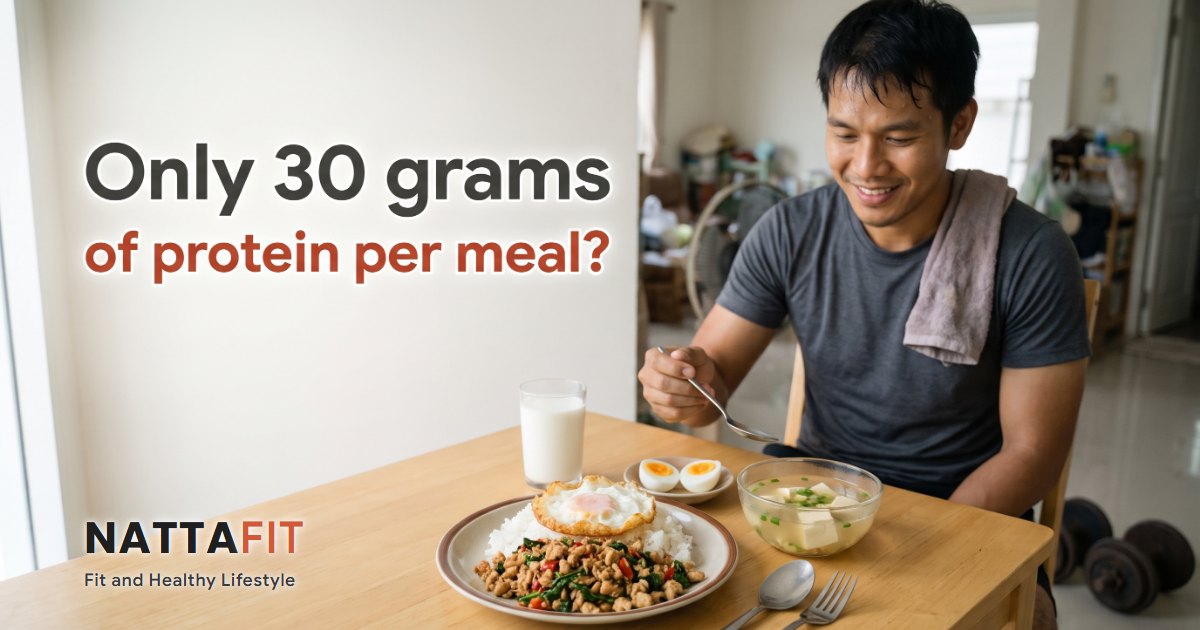
Can your body only use 30 grams of protein per meal?
In this article 9 sections
"Anything over 30 grams of protein in one meal is wasted. Your body can't use it. You just pee it out."
This line has been going around gyms and weight-loss groups for years. So some people weigh out their chicken breast to the gram and set alarms to drink a shake every three hours. Others are so busy they only get one real meal a day, at dinner, and then sit there worrying that their muscles are melting away.
You'd think there was a bouncer standing at the door of your stomach, counting grams. Thirty in? He blows the whistle. "We're full. Everybody else, the toilet's that way." 😂
Your body doesn't work like that. Here's where the 30 came from, what a newer study ran into, and how to actually spread your protein across the day.
🤔 Where did 30 grams come from?
First, a quick picture of what muscle is doing all day. It isn't just sitting there. It's constantly tearing out old bits and building new ones, like a house that's always under renovation. Protein from food is the bricks. Lifting weights is the site foreman shouting "Get to work!" Bricks with no foreman, and nothing gets built. A foreman with no bricks, and the crew just stands around scratching their heads. 🤷
A bit over ten years ago, a set of experiments had young men lift weights, drink different amounts of protein, and then measured how fast the muscle renovation went. The results looked alike: up to about 20–25 grams, the rate climbed to its maximum. Beyond that it barely moved, and the body burned more of the extra for energy.
In 2015, researchers pooled several of these studies and scaled the numbers to body weight. Young men needed about 0.24 grams per kilogram (around 17 grams for a 70 kg person). Older men around 70 needed more, about 0.40 grams per kilogram (around 28 grams). From there, "20–30 grams per meal" turned into a rule everybody repeats.
The catch: those studies gave about 45 grams at most and measured for six hours at most.
Picture a noodle stall with a four-basket cooker. It can cook four bowls at a time. Ten customers turn up, and it still cooks four at a time. If you watched for the first five minutes and concluded "this stall only sells four bowls, the rest get sent home," the auntie running it would give you a look. The other customers just wait a bit longer. Everybody eats in the end. 🍜
How many bowls you can cook at once isn't how many you can sell in a day. The 2023 study simply stood outside the stall for longer.
🥛 The 100-gram experiment
A team at Maastricht University in the Netherlands went to a lot of trouble here. They gave a dairy cow a four-day drip of tagged amino acids so the protein in her milk carried a traceable marker. That milk became the protein drink. Once people drank it, the team could follow where the protein from that glass ended up. GPS for protein, basically. Honestly, that cow deserves a spot on the author list. She did more work than anyone. 🐄
The volunteers were 36 healthy men aged 18 to 40 who exercised one to three times a week but didn't lift regularly. Each did an hour of full-body weight machines, then was randomly given a drink with 0, 25 or 100 grams of milk protein. After that they lay there for 12 hours while blood was drawn about once an hour and a muscle sample was taken from the thigh four times.
Twelve hours of needles and biopsies. Whoever signed up for that deserves a thank-you. 🙏
What they found:
- The 100-gram group built more muscle protein than the 25-gram group: about 20% more in the first four hours, and about 40% more from hour 4 to hour 12.
- Burning protein for energy went up only a tiny bit compared with what went into building. The body didn't dump the extra like everyone assumed.
- At the 12-hour mark, the 100 grams still wasn't fully digested. Only about half had made it into the bloodstream, and several measures hadn't come back down to baseline, so the true numbers are probably even bigger than what was measured.
As the chart shows, about 4.5 grams of protein from the drink ended up in muscle in the 25-gram group, and about 13 grams in the 100-gram group. Almost three times as much.
Hold on! Don't run off to mix a 100-gram shake just yet. ✋ As a share of what was drunk, the 25-gram group put about 18% into muscle and the 100-gram group about 13%. Buying in bulk didn't get you a better price per gram. But nothing went off in the fridge either. It wasn't wasted the way people fear. The body just worked through it over a longer stretch.
🙋 Did anyone push back?
Yes. A splashy study travels like news in a family group chat: it gets forwarded faster than anyone finishes reading it. 📲😅
In 2024, two sports nutrition researchers, Witard and Mettler, wrote a commentary in a sports nutrition journal. Their point: the finding is a real advance, but people were reading too much into it, enough to throw out the idea of spreading protein across meals altogether. The volunteers weren't trained lifters, and newer data hint that women who lift may not respond the same way. The original team wrote a reply the same year. The debate is still going.
I want to show you the women's side too. In 2025, the same Maastricht team ran a study in 36 women with an average age of 23. They did a leg workout, then were randomly given 20 grams of whey, 20 grams of canola protein, or a calorie-free placebo drink, and were measured for five hours.
The workout alone got the renovation crew going full speed. The protein groups didn't clearly rise above the placebo group.
That doesn't mean women don't need protein. It means there are very few studies in women, and the results haven't settled. What we know about protein per meal right now is like a shirt cut to fit young men. Anyone can put it on, but nobody's checked whether it fits. (This study was co-funded by dsm-firmenich, which made the canola protein used in it, and one of the researchers works for that company.)
🍱 Is spreading it out better than one big meal?
This is the other half of the same belief: if one meal can only use 30 grams, you'd better split it evenly, like a market vendor ladling curry into bags so every bag is exactly the same.
The study people love to quote is from 2014, with 8 people around age 37. Everyone ate about 90 grams of protein a day. One pattern spread it at about 30 grams per meal. The other went 11 at breakfast, 16 at lunch and 63 at dinner. The even pattern built about 25% more muscle protein over 24 hours. (Two of the researchers had been paid for talks by the US National Cattlemen's Beef Association.)
Eight people. That's not even one full table at a Chinese banquet. 🤣 And the studies that came after didn't get the same result.
- A 2022 Danish study in 24 men and women aged 65 to 80 compared an even pattern with one where 66% of the day's protein came at dinner. Muscle built protein at about the same rate (2.16 vs 2.23% per day). It was funded by the Innovation Fund Denmark and Danish Crown Ingredients, part of one of Denmark's biggest pork producers.
- A 2024 study had 43 women aged 20 to 44 with overweight cut their food by 20% for eight weeks, then manage on their own for another eight. The even group and the dinner-heavy group lost fat and kept muscle the same.
- A 2020 review that went through all the research on this concluded the evidence is too thin and too contradictory to call. What's clearer is: get enough over the whole day first. An uneven day that includes one properly high-protein meal might be just as good as an even day where every meal comes up short.
So: spreading it out does no harm, and if it's easy for you, go ahead. But don't stress on the days life hands you a big dinner.
📅 How much do you need in a whole day?
The general recommendation for adults is 0.8 grams per kilogram of body weight per day. That number is the floor, not the finish line. Think minimum wage: you'll get by, but if you want to build an extension on the house, you need a bigger budget.
A 2018 analysis pooled 49 trials with 1,863 people. Everyone lifted for at least six weeks, and the groups who got extra protein were compared with those who didn't.
- The extra-protein groups gained about 0.3 kg more lean mass and about 2.5 kg more on their one-rep max.
- But lifting alone already added about 27 kg to the one-rep max on average. Lifting is the lead actor. Protein is the supporting role. However good the supporting actor is, if the lead never shows up, there's no show.
- The benefit kept growing up to a total of about 1.6 grams per kilogram per day. Above that, no extra muscle showed up, like watering a plant whose soil is already soaked. It doesn't grow any faster. That cut-off isn't firm, though: the plausible range runs from about 1.0 to 2.2 grams, and it didn't quite reach statistical significance.
- The older the participants, the smaller the effect of extra protein. Part of that is because studies in older adults gave very little extra, around 20 grams a day on average.
A bigger 2022 analysis of 74 trials pointed the same way: more protein helps a little when you lift. People under 65 saw a benefit at 1.6 grams per kilogram or more. People 65 and up saw it at 1.2–1.59 grams, but that evidence is weak: removing a single study made it disappear, and no study has ever had older adults eat as much as 1.6 grams.
In 2025, other researchers challenged how the 2022 analysis was calculated. The authors replied and re-ran it with the four questioned studies removed. The result stayed positive, just a little smaller.
In real numbers, for someone who weighs 60 kg:
- 0.8 g = about 48 grams a day, to avoid falling short
- 1.2 g = about 72 grams a day
- 1.6 g = about 96 grams a day, for someone who lifts and wants the most muscle out of it
If you have kidney disease, or your doctor has you limiting protein, talk to them before you add more.
🍳 What it looks like on a plate
No need to get the calculator out. If I had to weigh my chicken breast at every meal, I'd give up chicken long before I gained any muscle. 🤣 Your palm is a portable scale that never needs batteries: a palm-sized piece of meat or fish (not counting fingers) has roughly 20–30 grams of protein.
Rough protein amounts for common foods, in Thailand and elsewhere. Sizes and brands vary, so check the label.
- 1 egg: about 6–7 g
- 100 g cooked chicken breast (about a palm): about 30 g
- 100 g grilled fish or salmon: about 20–25 g
- 100 g firm tofu: about 10–15 g
- 200 ml cow's milk: about 6–7 g; soy milk about 4–7 g depending on the brand
- 150 g Greek yogurt: about 15 g
- 1 cup cooked lentils or kidney beans: about 15–18 g
- 1 plate of steamed rice: about 4–5 g
Where most people fall short isn't a dinner that's too big. It's a breakfast with almost no protein. Coffee and Thai fried dough sticks, plain rice porridge with pickled greens, toast and jam, a croissant and a latte. All delicious. But line them up for a protein inspection and the fried dough stick would be staring at its shoes. 🙈 Add two eggs and a carton of milk and you're near 20 grams.
A sample day for a 60 kg person who lifts and wants about 90–100 grams:
- 🌅 Breakfast: 2 boiled eggs and a carton of soy milk, about 20 g
- ☀️ Lunch: holy basil chicken with a fried egg, about 25–35 g depending on how generous the stall is
- 🍵 Afternoon: a cup of Greek yogurt, about 15 g
- 🌙 Dinner: steamed fish or chicken breast, about one and a half palms, plus tofu in a clear soup, about 35–40 g
And if your dinner comes in at 50–60 grams, don't panic. There's no bouncer sending your protein to the toilet. 😂
👵 Who should pay extra attention to each meal
Older adults. Ageing muscle gets a little hard of hearing. 👂 Speak softly and it doesn't catch it, so you have to speak up, which means more protein per meal to get the full effect (the 2015 analysis above put it at about 0.4 g per kilogram, around 25 grams for a 60 kg person). Many older people also eat less, and breakfast might be one small bowl of congee. For this group, aim for a real serving of protein, around 25 grams, at each meal rather than saving it all for dinner.
People who can't eat much, such as those on weight-loss medication or anyone who fills up fast. If you wait to catch up in one meal, you often won't hit your daily total. It's like doing all your homework the night before it's due: good intentions, not enough time. Several smaller protein-rich meals make the total easier to reach.
People doing intermittent fasting or two meals a day. Good news: the 2023 research team thinks their results may explain why eating within a limited window doesn't seem to cost people muscle, as long as the daily total is there.
✅ The ready-to-use version
1. 🧮 Count the whole day first. If your daily total isn't there yet, don't worry about whether one meal went over 30.
2. 🏋️ If you lift, aim for about 1.2–1.6 grams per kilogram per day. Beyond that, research hasn't shown extra muscle gains.
3. 🍛 If one meal is the easy one to eat a lot at, eat a lot at it. It isn't wasted. Your body just takes longer to digest it.
4. 👵 If you're older or can't eat much, make every meal carry real protein, starting with breakfast.
5. 💪 Lift. A whole pile of bricks won't build an extension if the foreman never turns up.
No need to bring a kitchen scale to lunch. No need to set a 2 a.m. alarm for a protein shake. ⏰😴
Muscle doesn't grow because you're good at counting. It grows because you keep lifting. 💪
References 10 sources
- Trommelen J et al. The anabolic response to protein ingestion during recovery from exercise has no upper limit in magnitude and duration in vivo in humans. Cell Rep Med 2023 (full text)
- Witard OC, Mettler S. The Anabolic Response to Protein Ingestion During Recovery From Exercise Has No Upper Limit in Magnitude and Duration In Vivo in Humans: A Commentary. Int J Sport Nutr Exerc Metab 2024 (article) and the original team's reply (article)
- Boot N et al. Ingestion of 20 g Whey or Canola Protein Does Not Further Increase Muscle Protein Synthesis Rates During Recovery From Resistance Exercise In Healthy, Young Females. J Nutr 2025 (full text)
- Moore DR et al. Protein ingestion to stimulate myofibrillar protein synthesis requires greater relative protein intakes in healthy older versus younger men. J Gerontol A Biol Sci Med Sci 2015 (article)
- Mamerow MM et al. Dietary Protein Distribution Positively Influences 24-h Muscle Protein Synthesis in Healthy Adults. J Nutr 2014 (full text)
- Justesen TEH et al. Comparing Even with Skewed Dietary Protein Distribution Shows No Difference in Muscle Protein Synthesis or Amino Acid Utilization in Healthy Older Individuals: A Randomized Controlled Trial. Nutrients 2022 (full text)
- De Leon A et al. Daily Dietary Protein Distribution Does Not Influence Changes in Body Composition During Weight Loss in Women of Reproductive Years with Overweight or Obesity: A Randomized Controlled Trial. J Nutr 2024 (article)
- Hudson JL et al. Protein Distribution and Muscle-Related Outcomes: Does the Evidence Support the Concept? Nutrients 2020 (full text)
- Morton RW et al. A systematic review, meta-analysis and meta-regression of the effect of protein supplementation on resistance training-induced gains in muscle mass and strength in healthy adults. Br J Sports Med 2018 (full text)
- Nunes EA et al. Systematic review and meta-analysis of protein intake to support muscle mass and function in healthy adults. J Cachexia Sarcopenia Muscle 2022 (full text), the 2025 critique (full text) and the authors' reply (full text)
This article is general information, not medical advice. If you have a health condition, are pregnant, or take medication, check with your doctor before changing how you eat or train.