7 min readOh Natta ·
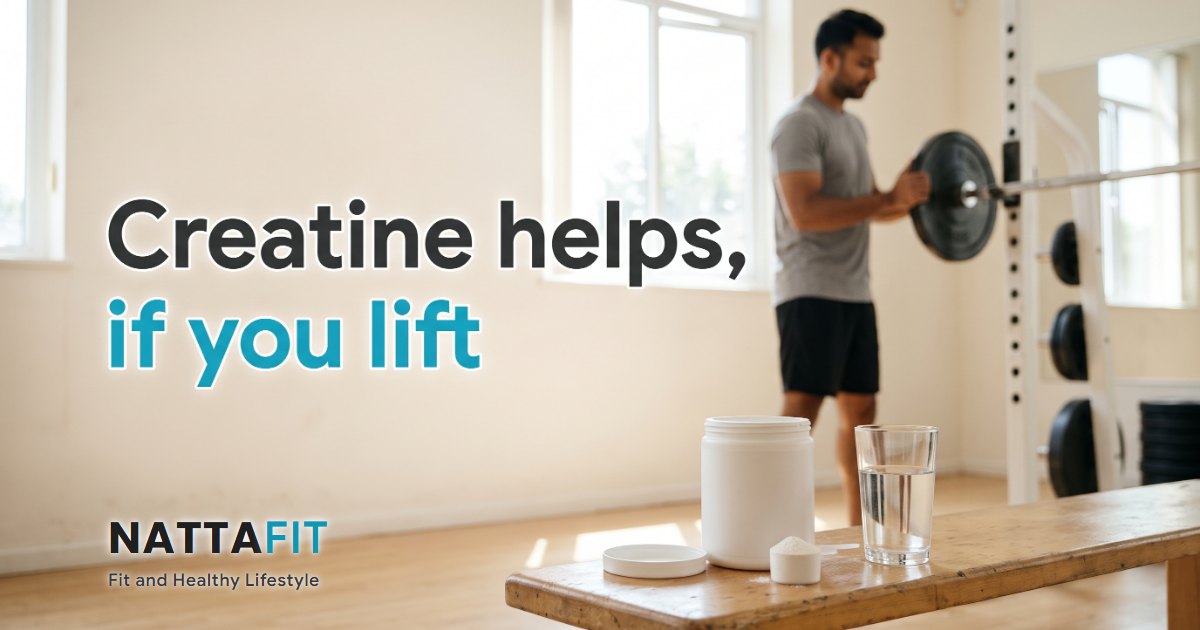
Creatine helps, if you lift
In this article 7 sections
"Creatine? That's for bodybuilders. It makes you all puffy."
"Creatine's basically cheating. You take it and the muscle just shows up."
I hear both of these about equally. The first one scares off people who'd actually benefit. The second one gets people to buy a tub, set it on the shelf, and wait for muscle to appear on faith alone. 🙏
Both are wrong. Today I'll walk you through what the latest research says: who it helps, who it doesn't, and by how much.
🧪 What it is and where it works
Creatine is something your muscles store as a quick backup energy supply, used for short, hard efforts: a set of lifts, a sprint, driving up fast out of a squat. Your body makes some of it, and the rest comes from food, especially meat and fish.
A supplement just tops that backup tank up. The last set, where you'd normally run out of gas, might leave you enough to push out one or two more reps. People who are vegetarian or eat little meat usually start with a lower tank, so they tend to see a clearer effect.
One or two reps a set doesn't sound like much. But lift for a whole year and it adds up to a lot more work for your muscles. And that's exactly why creatine doesn't build muscle by itself. It just lets you train more. If you don't train, there's nothing for it to help with. 🤷
Oh, and it isn't a steroid, and it isn't banned in sport either.
🏋️ If you already lift, what do you get?
A 2024 analysis pooled 23 trials in adults under 50, 509 people in total. Everyone did the same lifting. The only difference was creatine or a placebo powder. The creatine groups' max lifts went up more: about 4.4 kg more on upper-body lifts, about 11 kg more on lower-body lifts.
For people 50 and older, a pooled analysis of 22 trials with 721 men and women pointed the same way. The creatine groups gained about 1.4 kg more lean mass, and their strength gains were small-to-moderately bigger.
💧 Real muscle, or just water?
This is the part the people selling the powder don't talk about much. 🤫
Creatine pulls water into your muscles, and body composition machines count that water as "lean mass" too. So the muscle gains in a lot of studies have some water mixed in.
In 2023 an analysis looked only at studies that measured muscle size directly, with ultrasound or MRI. It found creatine really did make muscles thicker, but only a tiny bit, a millimeter and a bit, and not clearly beyond chance either.
In plain terms: creatine helps more with strength than with size. If you're expecting your arms to visibly grow once you start, lower your expectations a little. The puffiness in the first week is water, not muscle. 😅
👩 If you're a postmenopausal woman
This group has the longest and most detailed creatine research of anyone, because it's a time when both muscle and bone drop fast, and people hoped the powder could help with both.
A two-year trial in 237 women
This study from Canada, published in 2023, followed 237 postmenopausal women with an average age of 59.
Everyone did supervised weight training three days a week and brisk walking six days a week. The only difference: half took creatine and half took a placebo. Then the researchers followed them for two years.
You can probably see it straight away: the two groups barely differed. Squat strength went up about the same. Lean mass went up slightly more in the creatine group, but in the main analysis it didn't reach the level where you can say the difference is real.
The clear difference was the 80-meter walk. The creatine group got about a second and a half faster, while the placebo group barely changed. As for the femoral neck, the top of the thigh bone, which is what the team most wanted to look at, it dropped about the same in both groups.
The picture across several studies
In 2026, an analysis pooled 7 placebo-controlled trials in postmenopausal women, 608 women in total. Here's what it found.
- Lean mass went up about 0.37 kg more than placebo on average. Not even half a kilo. A real effect, but a small one.
- Leg strength: about 7.5 kg more on the leg press. This one's clearer.
- Upper-body strength: not clear yet.
- Bone: the authors are fairly confident it doesn't help. Don't buy it hoping for this.
The studies that worked gave 5 grams a day or more, together with weight training. The studies that gave 1–3 grams a day without any training barely showed an effect.
But I have to be straight with you: you can't separate those two yet, because the low-dose studies were also the ones with no lifting. The authors themselves admit they can't untangle the effect of dose from the effect of training. What you can reasonably conclude: lift as well, and take the dose the successful studies used, to be on the safe side.
🤔 So is it worth trying?
I'm not saying everyone has to take it. But if you're asking whether it's worth considering, here's how I see it.
✅ Likely worth it: people who already lift regularly, two or three times a week, whether you're 25 or 65, and want a bit more strength. Especially if you eat little meat. It's cheap, the plain powder has no taste, and you just stir it into water and drink.
🙅 Don't get your hopes up: people who don't lift yet and think this powder will replace exercise. Buy a tub, put it on a shelf, and worship it, and the muscle still won't show up on faith alone. 😂 Spend the money on good shoes and coaching first. Much better value.
🩺 Talk to your doctor first: people with kidney disease, or who get their kidneys checked regularly. Creatine can push the creatinine in your blood up a little. That doesn't mean your kidneys are damaged, but your doctor needs to know you're taking it, or they could misread your blood work. In the two-year trial above, kidney-related problems were no different between the two groups.
✅ If you want to try it
- 🥄 Choose plain creatine monohydrate. It's the most-studied form. No need to pay extra for fancy-named versions.
- 📏 The usual dose is 3–5 grams a day. The two-year trial in women above used 0.14 grams per kilogram of body weight (about 8 grams for someone who weighs 60 kg). Taking it every day, consistently, matters more than what time you take it.
- 💧 In the first few weeks your weight may go up by about a kilo. That's water in your muscles, not fat. Some people don't notice anything at all.
- 🔎 Choose a product that's registered with your country's food or drug regulator and has third-party purity testing. Supplements are a loosely policed market.
- 📒 Drink enough water, take it consistently for two or three months, then check your training log to see whether your strength has moved.
Creatine is one of the few supplements with genuinely good evidence. But the things that really change the game are still the same three: weights that are heavy enough, enough protein, and sleep. Have those three, and creatine is a bonus that's worth the money. Without them, creatine is just a tub of white powder. 💪
📚 References 5 sources
- Wang Z et al. Effects of Creatine Supplementation and Resistance Training on Muscle Strength Gains in Adults <50 Years of Age: A Systematic Review and Meta-Analysis. Nutrients 2024 (full text)
- Chilibeck PD et al. Effect of creatine supplementation during resistance training on lean tissue mass and muscular strength in older adults: a meta-analysis. Open Access J Sports Med 2017 (full text)
- Burke R et al. The Effects of Creatine Supplementation Combined with Resistance Training on Regional Measures of Muscle Hypertrophy: A Systematic Review with Meta-Analysis. Nutrients 2023 (full text)
- Chilibeck PD et al. A 2-yr Randomized Controlled Trial on Creatine Supplementation during Exercise for Postmenopausal Bone Health. Med Sci Sports Exerc 2023 (full text)
- Naddafha S et al. Creatine monohydrate for lean mass, strength, and bone density in postmenopausal women: a systematic review and meta-analysis. J Int Soc Sports Nutr 2026 (full text)
This article is general information, not medical advice. If you have a health condition, are pregnant, or take medication, check with your doctor before changing how you eat or train.