4 min readOh Natta ·
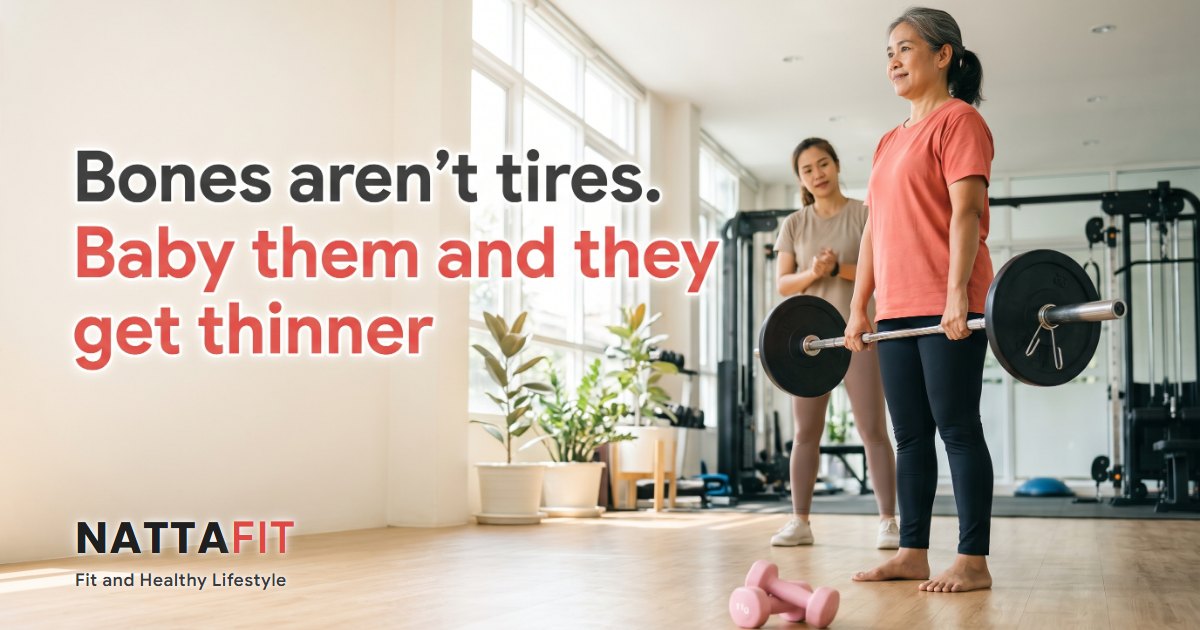
Bones aren't tires. Baby them and they get thinner
In this article 5 sections
"You're getting older, your bones are thinning. Don't lift anything heavy, you'll break something."
Women in their forties and fifties hear this a lot. Some hear it from family. Some hear it from their trainer, of all people.
It sounds caring. But research from the last ten years says that, for bones, this kind of caution can turn into the problem. 🤔
🦴 Bones don't wear out with use
A lot of people picture bones like car tires: the more you use them, the more they wear down. So they think bones need babying.
But bone is living tissue. It's constantly tearing down old bone and building new, and it builds according to the work it gets. On days it gets loaded with heavy force, it sends out the signal "I need to be stronger than this" and reinforces itself. If it never meets any force at all, it sees no reason to be strong.
The problem for women is that around menopause, estrogen drops and the tearing-down side starts working faster than the building side. This is when bone mass drops fastest in your whole life.
So what kind of force do bones need? Effort that's fast and heavy enough.
Walking, yoga, twenty reps with light dumbbells, these are good for your body in lots of ways. But for your bones, that's way too chill. Your bones aren't bothered enough to get any stronger. 😎
🔬 The trial that changed minds
In 2018 a research team in Australia ran a trial called LIFTMOR with 101 postmenopausal women. Every one of them had low bone mass, and some already had osteoporosis. These are exactly the people who normally get told to be the most careful.
One group trained lightly, the way it's usually recommended. The other group trained heavy, twice a week, thirty minutes a session. The main lifts were deadlifts, squats, and overhead presses, five sets of five, with a weight heavy enough that about five reps was all they could do. On top of that, they did jumping chin-ups: hang from a bar, then drop and land hard on the floor.
They trained for eight months, then looked at the results.
In the heavy group, density in the lower spine went up about 2.9%. In the light group, it went down 1.2%.
At the femoral neck, the top of the thigh bone, which is the most dangerous place to break in older people, the heavy group held steady. The light group dropped almost 2%.
And the thing everyone's afraid of? No one broke a vertebra from the training. On top of that, their hunched backs got straighter. 🙌
✋ Before you rush off to lift heavy
Please read this part too. It matters as much as the results.
💡 So how do you start in real life
I trained as an Orthopedic Exercise Specialist, and this is my favorite kind of work: taking people who've been told "you have to be careful" and getting them, safely, to the strength they should have.
I work from only a few principles.
🎯 Technique always comes before weight. Your hips, your back, and your core need to know their jobs first.
📈 Once your technique is solid, you have to be brave enough to work the weight up, to the point where you can only do a few reps a set. For bones, a load that's heavy enough is the whole point.
🤸 Impact work like jumping goes in once your knees and ankles are ready. Start small and low.
🩺 If you're getting close to this age and have never had a bone density test, ask your doctor whether you should. Then you'll know where you're starting from.
I'm 49 this year. So this isn't just about my clients. It's about me too. 🙋
Your bones don't need you to be more careful. They need you to be stronger. 💪
📚 References 3 sources
- Watson SL et al. High-Intensity Resistance and Impact Training Improves Bone Mineral Density and Physical Function in Postmenopausal Women With Osteopenia and Osteoporosis: The LIFTMOR Randomized Controlled Trial. J Bone Miner Res 2018
- LIFTMOR (full text from the Griffith University research repository)
- STOP-EM: a trial of resistance training in early menopause (ClinicalTrials.gov)
This article is general information, not medical advice. If you have a health condition, are pregnant, or take medication, check with your doctor before changing how you eat or train.