4 min readOh Natta ·
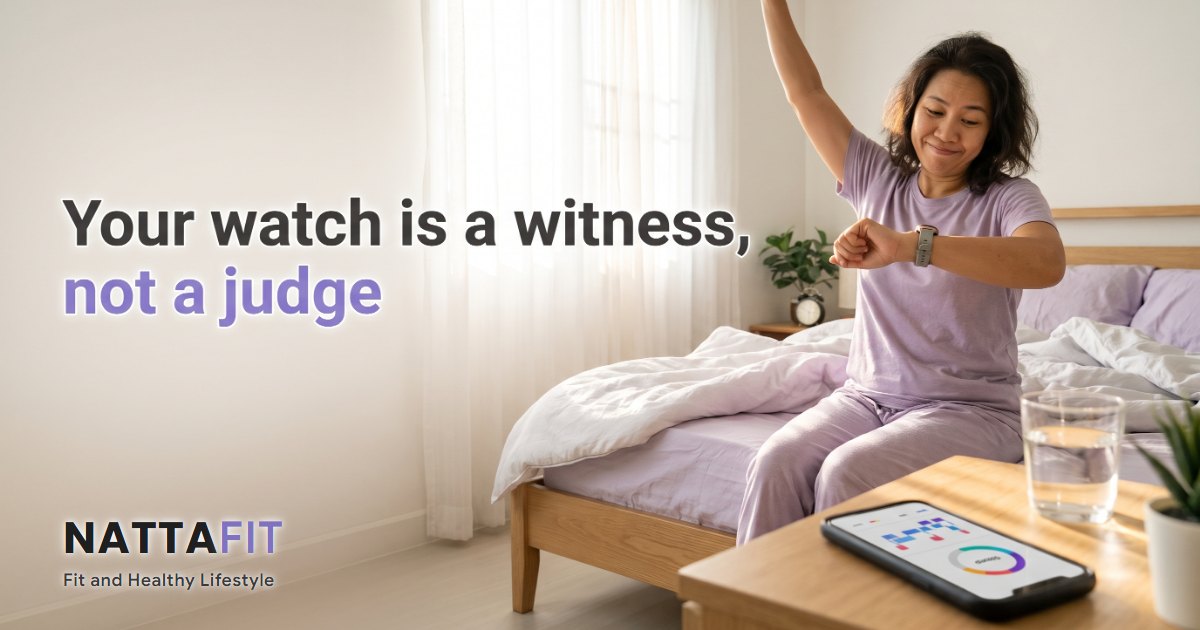
Your watch is a witness, not a judge
In this article 5 sections
You wake up, open the app, and your watch says: sleep score 58, only forty minutes of deep sleep, body not ready.
But you feel great.
So who do you believe? The watch, or yourself? 🤔
I use watch data in my coaching every day. It's one of my main tools. And because I've used it so much, I also know which numbers you can trust and which ones deserve a raised eyebrow.
✅ Numbers your watch measures well
Resting heart rate. Watches these days get very close to the real thing, especially at night while you're lying still. A morning heart rate that's unusually high for several days in a row is one of the earliest signs your body is carrying more than it can handle. It could be hard training, short sleep, stress, or a cold coming on.
Asleep or awake. Watches are pretty accurate at telling when you're asleep and when you're awake. A review pooling many studies found they catch sleep correctly more than nine times out of ten. So your total hours of sleep for the night are reasonably trustworthy.
Overnight HRV. HRV is heart rate variability, how much the timing between your heartbeats varies. It sounds odd, but a heart that varies well is a sign of a nervous system that's ready to go. A 2025 study compared several brands of watches and rings against a medical-grade heart monitor over more than five hundred nights, and found that overnight HRV from many models was very close to the real thing. But the study only had a dozen or so people, so it still needs confirming.
👂 Numbers to take with a grain of salt
Deep, REM, and light sleep. Your watch doesn't measure brain waves. It guesses your sleep stages from heart rate and movement. Several studies have found that when sleep is split into four stages, accuracy is only around 60 to 75%. So "forty minutes of deep sleep" could be way off. 😅
Readiness scores, body battery, sleep scores. Every brand calculates these with its own formula. Nobody shows you the formula, and it changes when the software updates. They're fun to look at, but I don't use them to decide what you should train today. 😉
⌚ How I read the numbers
Look at the trend, not one night. One morning with a higher heart rate than usual doesn't say much. A single glass of wine, a late dinner, or a hot bedroom can push it up. 🍷 What I look at is which way the numbers move over several days in a row.
Compare against yourself, not other people. Resting heart rate varies a lot from person to person. Your numbers and your friend's numbers can't be compared. What means something is your number today compared with your own normal.
Numbers go together with how you feel. Every morning my clients do a quick check-in in the app: how they feel, how they slept, whether anything hurts. Research on elite athletes found the same thing: what athletes report about themselves is valuable data, because it picks up things the devices don't see.
If your watch says you're doing badly but you feel good, I'll look further for anything else that's off. If there's nothing, you train as planned that day.
If your watch says you're doing well but you've felt bad several days in a row, I believe you first. 🤗
💓 So should you use HRV to plan your training days?
HRV is having a moment. A lot of people ask whether they should check it every morning and decide on a hard or easy day based on it.
There is research that tried exactly that, compared with following a schedule planned in advance. The HRV groups did slightly better, but the results aren't consistent yet, and each study did it very differently.
So for now I don't use HRV to make training decisions. What I look at is morning heart rate, sleep, how your actual training went, and what you tell me yourself. The evidence behind those is stronger.
Your watch is a good witness. It remembers everything that happens to your body. But it isn't the judge. What to do next has to be decided by someone who knows your real life. ⌚
📚 References 4 sources
- Contextual equivalence for accurate comparison of wearables requires transparency (commentary on Dial et al. 2025)
- Accurate comparison of wearables requires contextual equivalence
- Validating Subjective Ratings with Wearable Data for a Nuanced Understanding of Load-Recovery Status in Elite Endurance Athletes
- Performance of consumer wrist-worn sleep tracking devices compared to polysomnography: A meta-analysis. J Clin Sleep Med 2025;21(3):573–582
This article is general information, not medical advice. If you have a health condition, are pregnant, or take medication, check with your doctor before changing how you eat or train.